Shaping Perception Through Control of Light Light is not a singular condition. It exists in different qualities, each shaping perception in a distinct way. Among these, the most fundamental distinction is between diffuse light and directed light. Understanding this difference is essential, because it determines how we see form, depth, texture, and space. This distinction is not merely technical—it is perceptual. It defines whether a space feels calm or dramatic, flat or dimensional, neutral or expressive. Every visual environment, whether natural or designed, lies somewhere along the spectrum between these two extremes.
The Nature of Diffuse Light
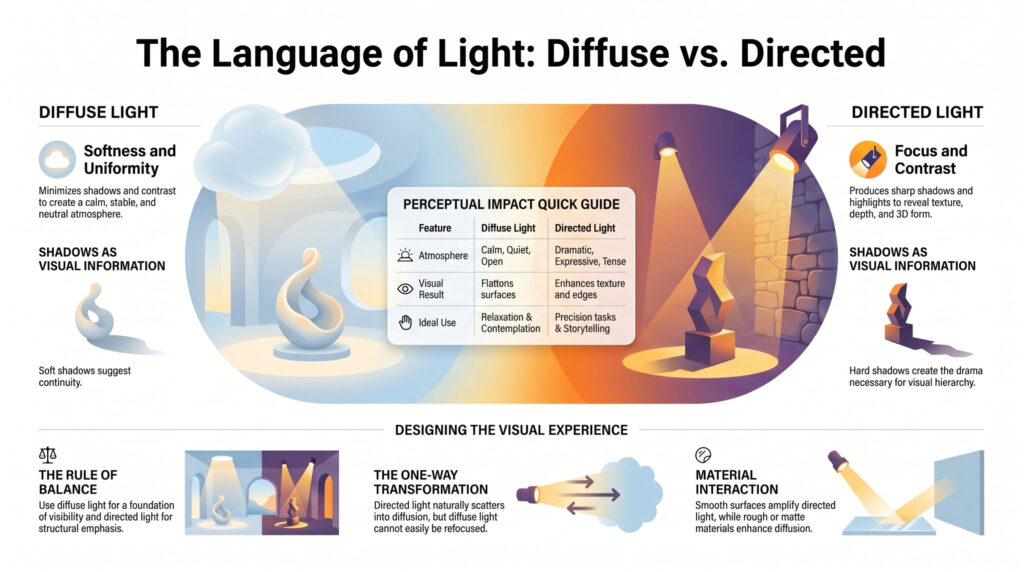
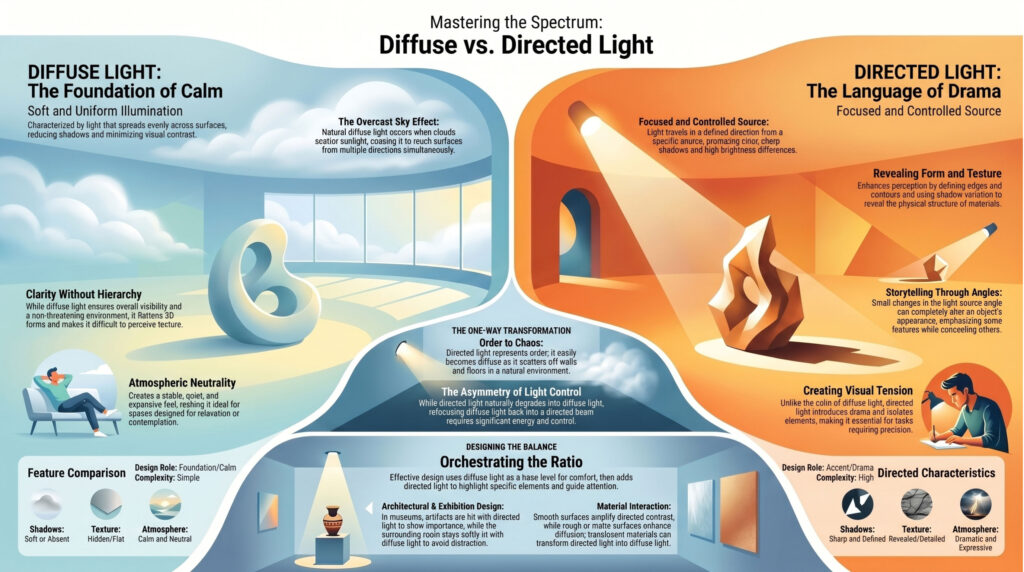
Diffuse light is characterized by its softness and uniformity. It spreads evenly across surfaces, reducing shadows and minimizing contrast. This type of light is commonly experienced under an overcast sky, where sunlight is scattered by clouds and reaches surfaces from multiple directions. Because of this scattering, diffuse light produces minimal directional cues. Objects appear evenly illuminated, and shadows—if present—are soft and barely perceptible. As a result, the perception of depth and form is reduced. In such conditions, the visual field becomes calm and homogeneous. Surfaces merge into a continuous experience rather than standing apart. This creates an atmosphere that feels stable, quiet, and neutral. However, this uniformity comes at a cost. Without strong shadows or highlights, it becomes difficult to perceive texture, material differences, and three-dimensional structure. Forms appear flatter, and spatial hierarchy becomes less distinct. Diffuse light, therefore, is not about emphasis—it is about clarity without hierarchy.
The Nature of Directed Light
In contrast, directed light is focused and controlled. It originates from a specific source and travels in a defined direction, producing clear and often sharp shadows. This directional quality introduces contrast. Surfaces facing the light become bright, while those turned away fall into shadow. This interplay creates depth, revealing the three-dimensional structure of objects. Directed light enhances perception by: Defining edges and contours Revealing textures through shadow variation Creating visual hierarchy through brightness differences Unlike diffuse light, directed light is expressive. It draws attention, isolates elements, and introduces drama into a scene. The position of the light source plays a crucial role. A slight change in angle can completely alter how an object is perceived—emphasizing certain features while concealing others. This makes directed light a powerful tool for storytelling and visual control.
From Order to Chaos: A One-Way Transformation
One of the fundamental properties of light is that directed light can easily become diffuse, but diffuse light cannot easily be refocused into a directed beam. When light interacts with surfaces, it scatters. Reflections from walls, floors, and objects gradually break down its directionality, transforming it into diffuse light. This process happens naturally in most environments. However, once light is scattered, regaining its original direction requires significant control and energy. This asymmetry highlights an important principle: Directed light represents order, while diffuse light represents dispersion. In design, this means that creating focus requires intention, while diffusion happens effortlessly.
Surface, Material, and Reflection
Light does not act alone—it interacts with materials. The same light behaves differently on matte, glossy, textured, or reflective surfaces.
Matte surfaces absorb light, producing soft and diffused reflections. Glossy surfaces reflect light sharply, increasing brightness and contrast. Textured surfaces create variation, enhancing depth perception.
This interaction determines how we perceive form and materiality. For instance, reflective surfaces can appear brighter than they actually are, while dark matte surfaces can suppress visual detail. Thus, material selection in design is as much about light behavior as it is about aesthetics.
Perception and Human Experience
The human visual system relies heavily on contrast and shadow to interpret space. Directed light provides the information necessary to understand form, distance, and orientation. In environments dominated by diffuse light, this information is reduced. While such spaces feel comfortable and non-threatening, they can also lack clarity and spatial definition. This has practical implications: Tasks requiring precision and detail benefit from directed lighting Spaces designed for relaxation or contemplation benefit from diffuse lighting Diffuse light reduces visual tension, while directed light introduces it. Thus, lighting is not just about visibility—it is about how much information the viewer receives and how it is structured.
Shadows as Information
Shadows are not merely byproducts of light—they are carriers of visual information. In diffuse lighting, shadows are soft or absent, which reduces depth cues. In directed lighting, shadows become sharp and defined, clearly indicating the relationship between objects and their environment. The type of shadow affects perception: Soft shadows suggest continuity and calmness Hard shadows create contrast and drama Through shadows, light communicates structure. Without them, perception becomes ambiguous.
Combining Diffuse and Directed Light
In practice, most effective lighting designs do not rely solely on one type. Instead, they combine diffuse and directed light to balance clarity and emphasis. Diffuse light establishes a base level of illumination, ensuring overall visibility and comfort. Directed light is then added to highlight specific elements, introduce depth, and guide attention. This combination allows designers to: Maintain visual comfort while creating hierarchy Reveal form without overwhelming the viewer Balance uniformity with focus For example, in architectural spaces, ambient diffuse lighting may define the general environment, while spotlights or accent lighting draw attention to key features. In exhibition design, this balance is crucial. Artifacts are often illuminated with directed light to enhance their form and importance, while the surrounding space remains softly lit to avoid distraction.
Lighting as Spatial Language
Diffuse and directed light function as a language through which space communicates. Diffuse light speaks of openness, neutrality, and calm Directed light speaks of focus, importance, and drama By adjusting the ratio between these two, designers can control how a space is perceived and experienced. A space dominated by diffuse light feels expansive and undemanding. A space shaped by directed light feels intentional and expressive. The choice is not about which is better, but about what the space needs to communicate.
Material and Surface Interaction
The effect of diffuse and directed light is further influenced by the materials it interacts with. Smooth, reflective surfaces amplify directed light, increasing contrast Rough or matte surfaces scatter light, enhancing diffusion Translucent materials transform directed light into soft, diffuse illumination Thus, lighting design cannot be separated from material design. The final perception is always a result of their interaction.
Conclusion: Designing the Balance
Diffuse and directed light are not opposites in conflict—they are complementary forces that define visual experience. Diffuse light provides the foundation. Directed light provides the structure. Together, they create environments that are both readable and expressive.
To design with light is to decide:
- What should be seen clearly
- What should stand out
- What should remain subtle
Ultimately, the mastery of lighting lies not in choosing between diffuse and directed light, but in orchestrating their balance to shape perception, guide attention, and create meaning.
